
When I was a young woman living at home with my parents, working at the library and attending studio classes at the Glassell School of Art in Houston my father made me a drawing table. He sent my mother and me to the hardware store with a list and we came home with two lengths of pipe and flange fittings, screws, a sheet of plywood, a piece of trim wood, and several heavy-duty hinges. My father proceeded to hang the sheet of plywood on the wall of my bedroom so I could lift it up and screw the two pipe pieces in to make the front legs of the table. The table as such was nicely slanted and the wood trim at the outer edge kept my pencils and charcoal sticks from sliding off the edge. My bedroom was tightly packed so, when not in use, the pipes could be removed and the drawing table lowered back to the wall. This was the first of many creative spaces in my life.

When we designed our home in the Texas Hill Country we planned for a studio space on the second floor. The entire floor is open concept with a separate powder room and a wet room with a deep sink and cabinets. Here, in the studio, with a wall of windows on one side, doors opening to a small balcony on the other side, and the hills all around it is as if you are working in a large tree house.
On the right wall as you enter the space are drawings, photographs, and a small collection of frames.

This vintage candle sconce from a shop in Galveston hangs on the wall above the frames. It sets the mood for our creative space.
Let’s take a look around together!

This antique multi-drawered architectural drawing cabinet is at the entrance to the space. Hanging above it are framed pressed flowers from our land. On top are cold porcelain flowers in progress from my series called Ghost Flowers.

The drawers now hold completed works such as these watercolor botanicals from my Floralegium series.

Another drawer contains mezzotints and handmade books of intaglio and mezzotint prints bound in leather repurposed from vintage gloves.

Here is a view as you look out into the room. There are four large worktables and an easel with an American-French press in the center of the space.

Supplies are kept in four glass fronted cabinets positioned between the windows along the left side. This cabinet holds supplies for mounting and framing the cold porcelain flowers and for wood finishing.

The second cabinet is devoted to printmaking. Inside you can see books about printmaking, tools for rocking a copper plate to create a mezzotint, and other tools for applying ink to the plate.

The inks for printmaking come in beautiful, lidded cans. Each time you end a day of printing you have to press a circular piece of waxed paper down on top of the remaining ink and seal the lid with masking tape to prevent the inks from drying. The geode and the twisted stem of a gardenia tree are inspiring natural objects.

Completed copper plates are cleaned with sunflower oil, wrapped in paper toweling and stored in expandable acid-free glassine envelopes.

Blank printing paper and sheets of roofing copper are kept in this large, granite topped industrial style flat file rolling cabinet. An oversized paper cutter and metal straight edges rest on top.

The sheets of roofing copper are cut to size for intaglio or mezzotint prints on this plate shear.

Ink is mixed on this glass top wrought iron table which is easily cleaned. The basket on top holds aprons and the one underneath has tarlatans in it. Tarlatan is an open weave somewhat stiff fabric used to wipe excess ink from an intaglio copper plate before it is printed. We can hang the tarlatans to dry on the wooden dowels beneath the table surface. This is a repurposed table inherited from my parents.

This heating plate on a metal stand is quite near the inking table. This is where we put a sheet of newsprint down and lay the inked plate on top of it to get warm. When it is warm we use the tarlatan to wipe the excess ink from the plate. Underneath is a small hand press and a heavy-duty tool used to remove the spine from books and to cut a large stack of paper straight. This tool is used in bookmaking and rebinding.

This is our American-French press. It was designed by Andre E. Beaudoin and manufactured for us by the Conrad Machine Company in Whitehall Michigan. They also manufactured our heating element.

The copper plates are placed on dampened 100% cotton rag paper made in France, covered in thick felt blankets and the wheel is turned pushing the plate under the metal roller and out the other side. The completed prints are still damp and benefit from a time in this drying rack in one corner of the studio. The drying rack is helpful for all flat work, including tea dyed paper and watercolor botanicals.
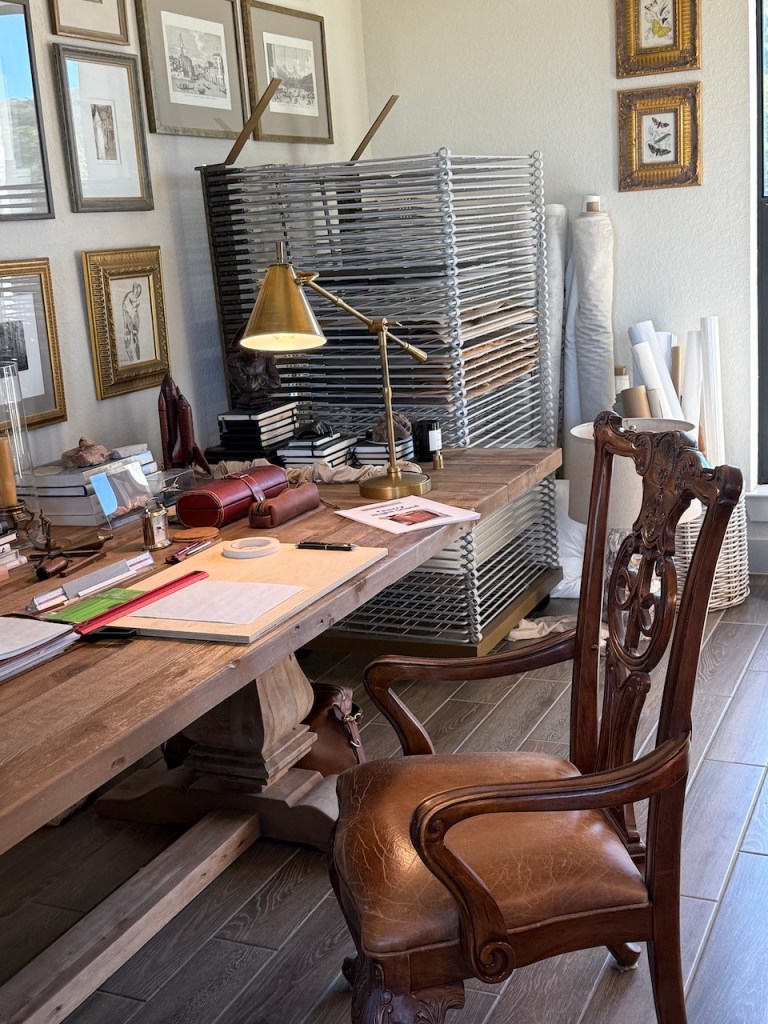
Here is another view of the drying rack and one of my husband’s worktable. This is where he makes the detailed hand drawings for his woodworking pieces. The table also holds a large Canon photo printer.

This long worktable made of reclaimed wood and purchased at a shop on Westheimer in Houston is where I create some of my textile art pieces and botanical watercolors.


The box with a key in it is an antique repurposed liquor cabinet. It makes a superb place to keep tubes of watercolor, mixing jars, and brushes!

Inside this cabinet are books illustrating plants and flowers. These have been collected over many years. The stack of books of Endemic Flora of Tasmania was discovered in a used bookstore in the French Quarter in New Orleans.

On the wall in front of all the glass fronted cabinets is the newest worktable. We purchased this table twenty years ago at a vintage market. It was a conference table from a company in Houston and had cigarette burns on the top of it. We used it as a desk for many years, then it was my husband’s work bench in the wood shop and now it is mine! There is a separate post about how I refinished it and painted the top in faux marble.


There are two drawers in the front of the table, one for textile work and the other for cold porcelain tools. The drawers exemplify how important it is to organize your creative space so you can quickly find what you need.

This cabinet contains lace, ribbons, and large pieces of folded fabric.


Vintage fabric and pieces in progress are sorted in baskets organized by type and purpose.

As you may imagine every inch of space is a valuable resource. My husband installed this shelf on the metal cross members under the stand for the press Here are the wooden blocks and supplies used in making cold porcelain flowers and old books without covers. The pages of the books are used to clean printmaking plates and tools after use.
Having a place where you can go to expand your creativity, a studio of the mind, is one of the most joyful spaces you can make for yourself. These latest three posts should give you something to think about – make it your own!
Discover more from from deep in the heart
Subscribe to get the latest posts sent to your email.


