


This is the story of the creation of a handwritten manuscript with tinted and illustrated opening letters for each chapter. As with most objects made by hand, the manuscript is the result of reading, research, reflection, and a sequence of laborious actions. Laborious meaning “a process or journey requiring considerable effort and time.” (Oxford Language dictionary). The story will be told in several parts with Part I being the description of the seeds of the idea and some of the initial decision-making about the content and process.

In April of 2024 an article titled ‘L’Espirit D’Espalier’ was published in The World of Interiors. The article appeared during my search for information on espalier or the training of a tree or vine to grow against a wall. Reading the article helped me develop and execute a plan for growing Asian jasmine on a three-sided foundation wall. More important, it introduced me to the head gardener to King Louis XIV, Jean Baptiste de La Quintinie, the creator of the kitchen gardens at Versailles in France or the Potager du Roi and the author of The Complete Gard’ner.


A desire to learn more about de La Quintinie and his garden led to my purchase of a gently used copy of Gardener to the King by Frederic Richaud, translated by Barbara Bray, and published in 2000. The illustration on the cover is a piece of the map of the garden. At the beginning of each chapter is a diagram of a pruning cut and the end of chapter there is an illustration is of a cutting tool used in pruning or general gardening. Only later would I learn the illustrations were taken from the book written by Jean Baptiste de La Quintinie.
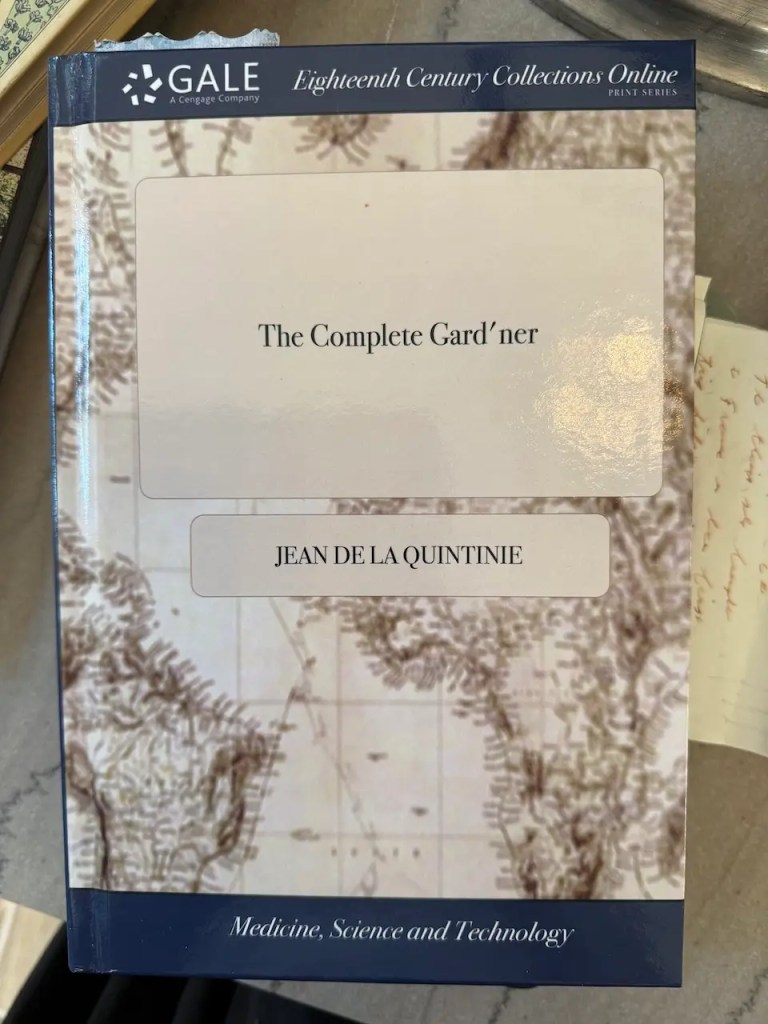
I was able to get a hard copy print of the digitized copy of the English version of the book translated by George London and Henry Wise.

The digitized copy was not very well done and difficult to read in parts as the last words in sentences rolled out of sight and the capitalization and spellings of words were different from contemporary capitalization and spelling. For example, the letter “f” was used in place of “s” sometimes, but not always. An example:
In the firft place to make a general fecurity for whole garden or plantation it will be neceffary to plant trees for defence thereof, fome diftance within the utmoft Bounds or Walls, in fuch manner as hereafter fpecified.
Comprehension tends to breakdown when we struggle to read and it won’t be surprising to learn that my interest in reading the text for understanding and information grew less and less.

On March 4, 2026 an article in the New York Times by Elly Fishman about an artist named Bethany Collins captured my attention. Ms. Collins had spent four months in 2024 handwriting Herman Melville’s Moby Dick on onion skin paper with a nib pen in midnight blue ink. She wrote on large sheets of the paper and the work was bound in three black cloth books.

During the interview Bethany Collins shared she had been inspired to do this by the 1974 work ‘The Picture of Dorian Gray’ by artist Allen Ruppersberg. Mr. Ruppersberg used a felt tip marker on raw, stretched canvas to copy the novel written by Oscar Wilde. He allowed himself to leave his errors in copying scratched through with the marker. Ms. Collins referred to a statement from the artist in which “Ruppersberg talks about transcription as the most intimate you can become with an author.” Collins said she was “…enamored with that idea.”


The first is a photograph of a garden we are developing beside the arroyo and the thick limestone rock bridge across it. The second is a photo of the bridge just after a rare hard rain in the hills. Gardening in the Texas Hill Country is a physical and intellectual challenge and a definite passion of mine. Transcribing the difficult to read text would provide me with an opportunity to rewrite the words for ease of reading and to think deeply about the words during and after the act of copying them. It would be acceptable to edit by spelling words, capitalizing them, and punctuating the document in a way familiar to me. Further consideration led me to devise a plan for responding to the text. I would, when copying a section about something I had dealt with in creating and caring for our garden, write a paragraph of two about my own experiences and knowledge building.
My reader response would be in a different color of ink to distinguish it from the words of Jean Baptiste de La Quintinie!
Part 2 will discuss choosing and organizing the materials for the piece. Part 3 will include visits to monasteries and museums to view illuminated manuscripts as well as reading about those who created the manuscripts.
Discover more from from deep in the heart
Subscribe to get the latest posts sent to your email.